Search Results for: “Phillimore Parish Records”
Worcestershire Phillimore Parish Records (Marriages) Volumes 01 and 02 on one CD
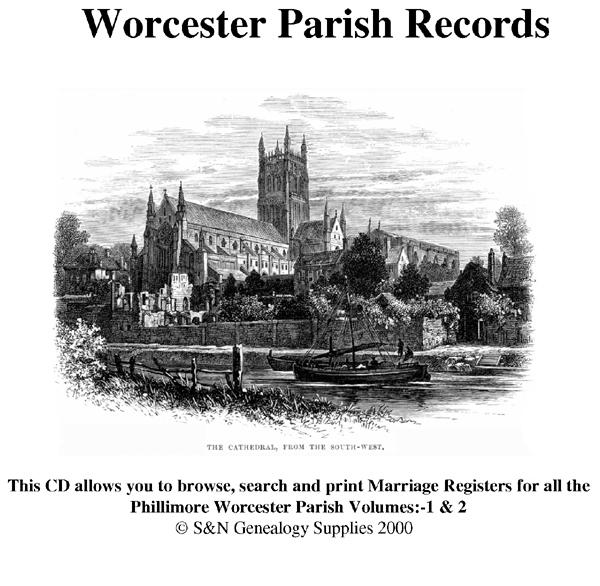
Marriage registers for all the Phillimore Worcester parish volumes. Alderminster 1613-1812; Alstone 1550-1805; Birtsmorton 1539-1812; Bradley 1630-1812; Bushley 1539-1837; Churchill in Halfshire 1564-1812; Church Lench 1702-1812; Cleeve Prior 1599-1837; Eastham 1571-1837; Elmbridge 1570-1812; Frankley 1604-1812; Hanley Child 1754-1836; Hanley William 1586-1837; Himbleton 1713-1812; Hinton in the Green 1735-1812; Huddington 1695-1812; Kempsey 1690-1812; Kington 1588-1836; Little Comberton 1540 More Info
Can't find what you're looking for? Try using our filter system to narrow down your search.
Available through our sister site GenFair
Surrey & Sussex - the Genealogists Library Guide (vol 4). Administrative Records for Surrey & Sussex Genealogists
The record of government, church and private estates contain a great deal of information likely to be of interest to genealogists. Deeds, for example, can be very useufl in tracing the descent of properties. Church records enable local clergy to be traced, and provide much information on parishioners. For Surrey and Sussex, much relevant material is in print, and readily available in libraries. Th...More Info
Poor Law Union Records Volume 3 - South-West England, The Marches and Wales
By Jeremy Gibson. The records of poor law unions of the 19th and early 20th centuries constitute a major, but under-used, source of genealogical data - partly because, prior to the publication of these books, it was difficult to know what was available. They set that right, and provide a detailed listing, county by county, of the extensive resources which may include information on your ancestors.
Birth and Baptism Records for Family Historians / Stuart A. Raymond
Registers of births and baptisms are vital sources for family historians. They have been kept by the Church of England, various nonconformist churches, the General Register Office, and various other bodies. There are also a variety of other records in which births and baptisms can be traced. This book gives an overview of all the sources worth searching, telling you where to look and how to unders...More Info
Marriage Records for Family Historians / Stuart A. Raymond
It is impossible to construct pedigrees without using marriage registers and other records. Marriages have been registered by a wide range of different bodies. This book describes these and other sources, and tells you where to look.
St Paul's Church (City Centre) 1813-1861 and the Cholera Burial Ground 1832 Burial Records
Transcriptions of burial records of St Paul's in central Sheffield and the common burial ground at Norfolk Park that was created especially for mass burials in the year of the great cholera epidemic.